The sheet we give every client. Four models, one effort dial, three ways to load your business in. Save it, share it, argue with it. Updated 9 Sep 2026.
01 · The four models
Haiku 4.5"the sprinter"SPEED ●●●● · COST ●○○○
Near-instant and the cheapest. Use it when the task is mechanical and volume is high.
Sorting & tagging anything
Pulling data out of emails/PDFs
Meeting notes → summary
Quick lookups & drafts
Sonnet 5"the workhorse"SPEED ●●●○ · COST ●●○○
The everyday default. Best smarts-per-dollar for 80% of real work.
Client emails & documents
Everyday coding
Research & analysis
Website & marketing copy
Opus 5"the heavy lifter"SPEED ●●○○ (FAST MODE) · COST ●●●○
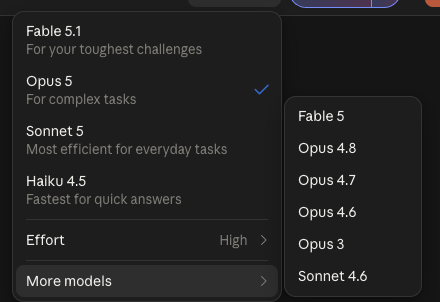
Opus 4.8 is our stable pick. Still in the picker under More models, and it has not surprised us on a long run. Opus 5 is the newer, most capable one: sometimes the best of the four, sometimes it trails off before the job is done. Both read entire codebases and contract stacks at 1M-token context.
Complex code & refactors
Long documents, many files
Proposals that must land
Judgment calls with nuance
Fable 5.1"the frontier"SPEED ●●○○ · COST ●●●●
The newest flagship family. Hardest reasoning, longest agent runs, best taste.
Strategy & pricing decisions
Agents that run for hours
Gnarly multi-step problems
"This really matters" work
House rule: start on Sonnet. Drop to Haiku the moment the task feels mechanical. Escalate to Opus or Fable when being wrong is expensive, a lost client or a broken deploy. For a long unattended run, Opus 4.8 is the one that has not surprised us.
02 · The effort dial (most people never touch it)
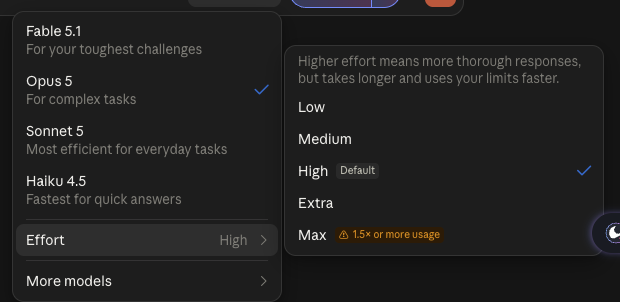
Every model also has an Effort setting, five steps from Low to Max: how long it reasons before answering. Low = instant answer. High = it works the problem first, and it is the default. Max uses 1.5 times your limits or more. This changes results more than most model swaps.
Cheat: a mid model on high effort often beats a big model on low effort for puzzles and debugging. But for taste, writing, strategy, judgment, the bigger model wins even on low. Puzzle → effort. Taste → model. Where it lives: claude.ai → the model picker beside the message box → Effort → Low, Medium, High, Extra or Max · Claude Code → type /model → pick model and effort
The picker sits beside the message box. Effort opens a submenu: Low, Medium, High (the default), Extra, Max.More models holds the older lineup. Opus 4.8, our stable pick, lives here.
03 · Teach it your business (the step that matters most)
STEP 1Make a Project, load your goldIn claude.ai: sidebar → Projects → new. Upload your website copy, your 2 to 3 best proposals, 5 real customer emails. Then set instructions: "Write like these examples. This is our tone, our offer, our prices." Every chat in the project now knows your business.
📁 Projects+ Add to project knowledge⚙ Set custom instructions
STEP 2Connect your real toolsSettings → Connectors. Plug in Gmail, Drive, Calendar (and any MCP tool your systems expose). Now it answers from your actual emails and files: "Summarise every open quote from this month's email."
🔌 ConnectorsConnected: Gmail🔍 Search & tools
STEP 3Show, don't describeThe 3-example rule: paste two or three gold-standard outputs before you ask for a new one. Models copy patterns far better than they follow adjectives. "Professional but friendly" loses to three real examples, every time.
Here are 3 quotes we actually sent and won.
Match their structure, tone and length.
Now write one for: [new client details]
04 · When to use what, pin this bit
The task
Model
Effort
Plus
Label / sort / extract from 1,000 things
Haiku 4.5
LOW
Clear format example
Reply to a customer email
Sonnet 5
LOW
3 past replies as examples
Write a proposal or quote
Opus 5
MEDIUM
Project with your winners loaded
Debug code / fix a spreadsheet formula
Sonnet 5 → Opus 5
HIGH
Paste the error, not a description
Read a 100-page contract / whole codebase
Opus 5
MEDIUM
1M context, give it everything
Pricing, strategy, "what should we do?"
Fable 5.1
MAX
Real numbers in, always
An agent that works for hours unattended
Fable 5.1 / Opus 5
HIGH
Connectors + tight instructions
Meeting → summary → action list
Haiku 4.5
LOW
Your action-list template
Keep this sheet · share it
This page: areyoufoundbyai.com/cheatsheet · ChatGPT edition: areyoufoundbyai.com/cheatsheet-chatgpt · Build-a-website edition: areyoufoundbyai.com/cheatsheet-vibecoding
Is AI recommending your business when buyers ask? Free 60-second check: areyoufoundbyai.com
free to share · updated when the lineup changesby Tech Horizon Labs